What is the difference between step-by-step bolt tightening and multi-stage tightening?
In core processes at automotive OEMs, such as final assembly and component manufacturing, the bolt tightening process directly determines the vehicle's assembly quality and operational stability. For high-requirement fastening scenarios like chassis connections, body structural parts, and powertrains, the standard single-stage tightening process can no longer meet production standards. Consequently, step-by-step tightening and multi-stage tightening have become mainstream processes. Many car manufacturers and assembly companies easily confuse these two processes; however, their operational logic, applicable scenarios, and core functions are completely different. This article, focusing on the volume production needs of OEMs, clearly analyzes the differences and application values of these two tightening processes.
First, let's discuss step-by-step tightening. Its core logic is to break down the entire tightening process into segments, primarily focusing on solving basic assembly issues such as bolts not aligning with holes smoothly, slow cycle times, and torque overshoot. Its main goals are adaptability and production efficiency. This process splits the sequence of bolt fastening actions, typically including multiple steps like low-speed thread finding, high-speed running down, snug/stall detection, and low-speed final tightening.
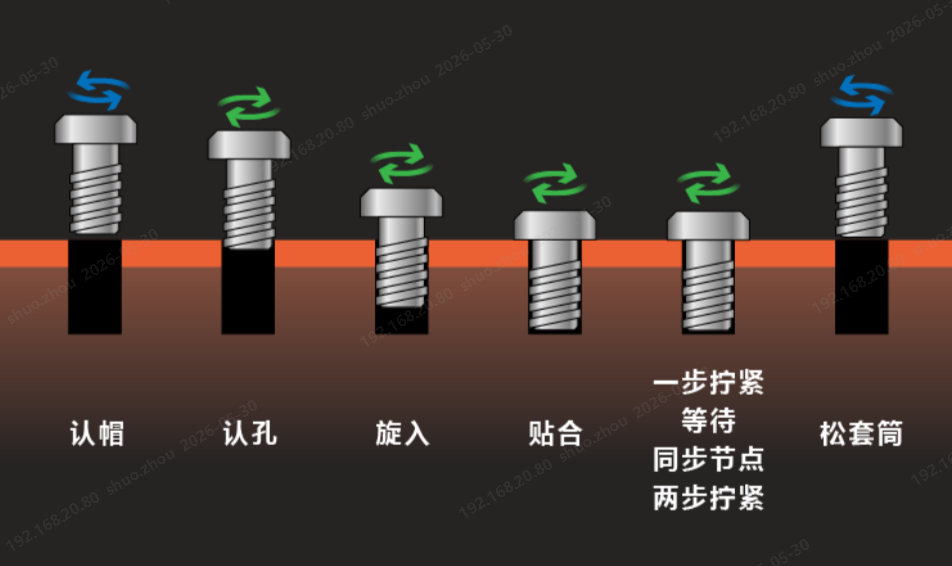
The designs for low-speed thread finding and reverse thread finding effectively correct the bolt's angle, ensuring smooth entry into the hole and preventing cross-threading or angled fastening.
The high-speed running down mode significantly improves operational cycle time, meeting the high-volume production needs of OEMs.
Finally, ending with low-speed tightening effectively avoids instantaneous torque overshoot, preventing bolt thread stripping and workpiece crush damage.
This process primarily addresses fit issues during assembly, balancing production efficiency with basic locking quality.
On the other hand, the core logic of multi-stage tightening is to break down the stress phases of tightening. Its main goal is to eliminate assembly stress, reduce torque relaxation, and improve fastening stability. It is mostly used for critical connecting components that bear heavy loads and frequent vibration. Common industry practices include two-stage or three-stage tightening processes, which are fundamentally different from step-by-step tightening.
Two-stage tightening: Tighten to a first preset torque, hold briefly to stabilize and release the internal stress generated by assembly, then tighten again to the standard final target torque.
Three-stage tightening (even more rigorous): After reaching the first torque target, reverse/loosen the bolt according to a standard angle to completely release residual stress on the contact surfaces and assembly gaps. Finally, retighten to the target torque. This process significantly reduces the risk of torque relaxation and bolt loosening over the long term during vehicle operation.
To briefly summarize the core differences:
Step-by-step tightening focuses on smooth process flow, preventing overshoot, and increasing production capacity. It solves assembly defects during the fastening process.
Multi-stage tightening focuses on stress relief, torque stability, and preventing loosening. It solves the problem of torque relaxation during subsequent product use.
In automotive OEM production, step-by-step tightening processes are often used for interior trim and ordinary sheet metal parts. Multi-stage tightening processes are commonly used for critical safety components like the chassis, suspension, and powertrain.
Implementing standardized tightening processes relies on professional intelligent tightening equipment. Danikor, adapting to the volume production needs of automotive OEMs, offers intelligent tightening tools that can set both step-by-step and multi-stage tightening modes. The equipment can precisely execute various complex process steps, including thread finding, high-speed running down, angular reverse/loosening, time-delayed torque holding, etc. The entire process is controlled by an automated program, eliminating manual operation errors. Additionally, the equipment supports full-process data recording and traceability, fully complying with the strict process control systems of OEMs. This effectively reduces quality problems such as bolt loosening and unstable torque, helping car manufacturers improve assembly quality and enhance production line efficiency.