In the process of smart manufacturing upgrades in automotive OEM (Original Equipment Manufacturer) plants, the tightening process, as a core link in vehicle assembly, directly affects vehicle safety, reliability, and service life. From engine cylinder block tightening and chassis suspension fastening to power battery pack assembly and body connections, the tightening accuracy of each bolt can impact the quality of the complete vehicle and its market reputation. Traditional pneumatic and hydraulic tightening equipment, limited by their structural drawbacks, have many pain points such as large torque fluctuations, poor consistency, and lack of data traceability. They can no longer meet the stringent quality control and intelligent production demands of OEMs. However, servo nutrunners, with their core advantages of precise control, intelligent management, and high efficiency adaptability, are gradually replacing traditional equipment and becoming the core choice for production line upgrades in automotive OEMs. Danikor has been deeply involved in the servo tightening field for over ten years. With its self-developed core technologies and customized solutions, its servo nutrunners are widely used in major automotive OEMs and supporting parts enterprises, becoming a reliable partner for OEMs in smart manufacturing.
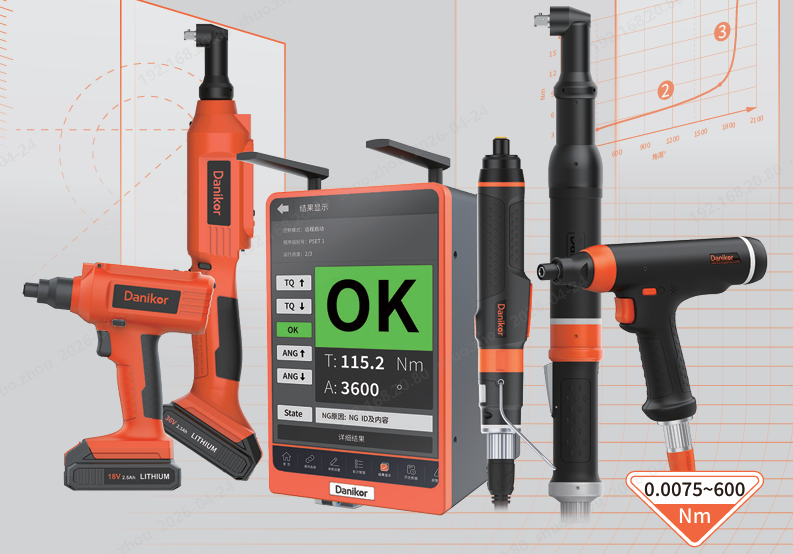
The core advantage of a servo nutrunner lies in its high-precision closed-loop control, which is also the primary reason it is suitable for critical stations in automotive OEMs. Unlike traditional pneumatic tightening equipment, which relies on air source pressure and suffers from large torque fluctuations, a servo nutrunner features a high-performance servo motor and torque-angle sensors. Using a closed-loop feedback control algorithm, it can collect key parameters like torque and angle in real-time during the tightening process, dynamically adjust the motor output, and ensure the tightening accuracy of each bolt with low tightening scatter. To meet the needs of different stations in automotive OEMs, servo nutrunners can flexibly set various tightening strategies such as step tightening, torque compensation, and angle monitoring. For example, during cylinder head tightening, a "snugging - re-tightening - final tightening" step control can be used to avoid cylinder head deformation caused by uneven bolt stress. During chassis bolt fastening, angle monitoring ensures the bolt is tightened to the correct position, effectively avoiding assembly abnormalities like stripping, floating, over-tightening, and under-tightening, building a defense against tightening errors at the source and ensuring the assembly quality of key vehicle components.
Digital full-process traceability is another core advantage that makes servo nutrunners suitable for the quality control systems of automotive OEMs. The automotive industry has very high requirements for product traceability. The tightening data for every bolt needs to be incorporated into the vehicle's warranty system for future after-sales liability determination and process review. A servo nutrunner can fully record data for each tightening cycle, such as torque curve, peak torque, tightening angle, operation time, and operator information. This generates an unalterable production record and enables seamless connection to the factory's MES (Manufacturing Execution System), achieving interconnection of production data. Through this system, automotive OEMs can monitor the tightening status of each station in real-time, quickly identify abnormal data, and trace the root cause of problems. This not only meets industry compliance and audit requirements but also continuously improves the assembly quality of the production line. Danikor's servo nutrunners are equipped with a self-developed data acquisition and analysis system, supporting functions like data export and abnormal alarms, adapting to the full-process quality control needs of OEMs.
Flexible adaptability and high efficiency, energy savings further highlight the advantages of servo nutrunners in mixed-model production at automotive OEMs. Current automotive OEMs mostly adopt a mixed-model production line where multiple vehicle models are assembled on the same line, demanding high flexibility from tightening equipment. Servo nutrunners offer visualized parameter setting via a touchscreen and can store multiple tightening programs. When switching vehicle models, no tedious debugging is needed; simply calling up the corresponding program enables quick adaptation, significantly improving changeover efficiency and meeting the needs of multi-variety, small-batch production. Simultaneously, servo nutrunners are electrically driven and do not rely on an air source. Compared to pneumatic tightening equipment, they reduce energy consumption by over 30%, are quieter, and produce no exhaust emissions, aligning with the green production philosophy of OEMs. Furthermore, the equipment has a compact structure, a low failure rate, and is simple and convenient to maintain. This can significantly reduce production line downtime, improve Overall Equipment Effectiveness (OEE), and help OEMs increase vehicle assembly tact time.
As a brand focused on the R&D and manufacturing of precision tightening equipment, Danikor's servo nutrunners deeply meet the needs of automotive OEMs and supporting industries. They are widely used in core stations such as final assembly, powertrain, power battery, and chassis suspension for both fuel-powered and new energy vehicles. Danikor has long served leading OEMs like BYD, Geely, Volkswagen, NIO, and Li Auto, while also covering supporting industries like automotive parts. Leveraging its self-developed high-precision control algorithms and customized multi-axis collaborative tightening solutions, Danikor can provide single-axis, dual-axis, and multi-axis servo tightening workstations based on the different station requirements of OEMs, achieving full-scenario adaptation from single bolt fastening to multi-station synchronous tightening. Its equipment not only boasts the advantages of high precision and high reliability but also provides comprehensive after-sales technical support and equipment calibration services, ensuring long-term stable operation of the equipment and helping automotive OEMs achieve smart manufacturing upgrades and enhance their core competitiveness.
With core advantages including high-precision closed-loop control, full-process data traceability, flexible adaptability, and high efficiency with energy savings, the servo nutrunner has become core equipment for smart manufacturing in automotive OEMs, solving many pain points of traditional tightening equipment. Danikor, as a professional brand in the servo tightening field, takes technological innovation as its core and customer needs as its guide, providing one-stop precision tightening solutions for automotive OEMs and related supporting industries, promoting high-quality industry development, and solidifying the quality defense line in vehicle assembly.