In industrial production such as automotive parts, 3C electronics, and precision equipment, the tightening process is a core link ensuring product structural stability and operational safety. Tightening errors may seem small, but they can lead to product loosening, failure, or even safety hazards. Tightening error-proofing cannot be achieved solely by standardizing operator behavior; it requires management throughout the entire production process across multiple dimensions. This article combines the application practice of Danikor tightening guns to detail the core considerations for tightening error-proofing, helping companies avoid tightening risks and improve production yield.
I. Source Control: Incoming Material Error-Proofing, Eliminating Basic Hazards at the Root
The first line of defense in tightening error-proofing is incoming material control. If the screws entering the tightening system have specification deviations or surface defects, even the most precise subsequent operations will lead to tightening failure. Two key points need to be considered in this link:
Strictly verify material specifications: Establish a standardized incoming material inspection process to check key attributes such as screw model, size, material, and thread accuracy. Prevent materials with incorrect specifications or thread damage from entering the production line, especially avoiding the misuse of easily confusable screws with similar specifications.
Specialized testing to eliminate hazards: Introduce automated methods such as screw length detection and thread integrity detection to verify key parameters of screws one by one, without the need for manual measurement. This improves inspection efficiency and avoids human judgment errors, ensuring that every screw entering the tightening process meets standards. Danikor's screw feeding equipment can interface with the tightening gun, incorporating a built-in detection mechanism to automatically screen out unqualified screws, laying the foundation for tightening error-proofing at the source.
II. Core Control: Equipment Error-Proofing, Relying on Smart Tools to Guard Key Links
Equipment control is the core of tightening error-proofing. Choosing high-precision, intelligent tightening tools combined with scientific monitoring strategies can effectively avoid various anomalies during the tightening process. This is also the core advantage of Danikor tightening guns. Three specific points need consideration:
1. Choose tightening tools with error-proofing and traceability functions.
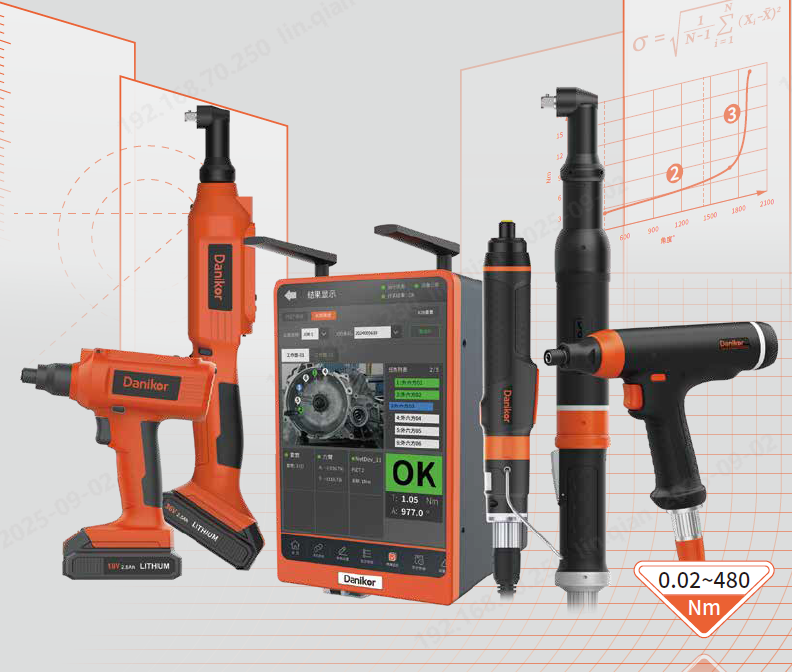
Prioritize tightening tools with high torque accuracy, stable performance, and full-process traceability capabilities, such as Danikor tightening guns. They use a self-developed high-precision algorithm following the ISO5393 standard and adopt high-performance brushless motors to achieve precise torque control. Simultaneously, they collect and store tightening data and torque curves in real-time, supporting connection to MES systems, providing complete data support for later quality traceability and problem troubleshooting, solving the pain points of "tightening without records, anomalies without evidence."
2. Establish a multi-dimensional anomaly monitoring system.
Use the built-in monitoring functions of the tightening tool to identify in real-time anomalies during tightening, such as floating height, thread stripping, re-tightening, over-tightening, and under-tightening. Danikor tightening guns come standard with various tightening strategies and are equipped with a data monitoring system. Once an anomaly is detected, an immediate alarm is issued and the operation is paused, preventing defective products from moving to the next process. Simultaneously, the anomaly type is automatically recorded for subsequent analysis and optimization.
3. Integrate positioning error-proofing devices to avoid position and sequence errors.
For problems like assembly position deviation or混乱 tightening sequence, auxiliary equipment such as positioning arms can be paired and interfaced with Danikor tightening guns. The tightening function can only be unlocked when the tool is moved to the preset correct assembly position. For processes requiring a specific tightening sequence, the operation order can be programmed into the equipment; if the sequence is not followed, the operation cannot be started. Even if the operator is negligent, it effectively avoids wrong or missing installations.
III. Auxiliary Control: Process and Personnel Error-Proofing, Forming Closed-Loop Management
Besides source and core links, process and personnel control are also indispensable. On one hand, establish a standardized tightening operation procedure, clarifying operating specifications, tightening parameters, and anomaly handling processes. Regularly calibrate and maintain tightening tools. For example, Danikor provides comprehensive tool calibration and technical support services to ensure tools maintain high precision over the long term. On the other hand, strengthen employee training,普及 common knowledge of tightening error-proofing, clarify key operation points, and at the same time, control through权限分级 to prevent unauthorized personnel from modifying tightening parameters, thereby reducing human errors.
Tightening error-proofing requires achieving closed-loop control across all dimensions of "material - equipment - process - personnel," with smart tightening tools as the core support. Relying on high-precision control, error-proofing functions, and a comprehensive traceability system, Danikor tightening guns are widely used in many industries, helping companies effectively avoid tightening anomalies, reduce defect rates, and build a solid line of defense for production quality.