In precision manufacturing fields such as automotive, 3C electronics, and home appliances, screw tightening is a key process affecting product quality. Repeated tightening, as a common assembly error, has long troubled many manufacturing companies. At best, it causes thread wear and abnormal preload in connections; at worst, it can lead to part loosening, breakage, and even product failure or safety accidents. With the development of intelligent manufacturing technology, the intelligent electric screwdriver, leveraging core functions like re-tightening error-proofing, has become an ideal solution to this problem, building a solid defense for assembly quality.
I. Repeated Tightening: A Non-Negligible Hidden Danger to Assembly Quality
Repeated tightening refers to the operation of applying torque again to a screw that has already reached its preset tightening state. In traditional manual assembly scenarios, due to issues such as operator visual judgment errors, procedural omissions, and tools lacking feedback mechanisms, re-tightening occurs frequently, and the risks it introduces span the entire product lifecycle.
At the micro level, repeated tightening exacerbates friction between the screw and the threaded hole, leading to wear and deformation of the thread profile. This destroys the fit precision of the thread pair and reduces the connection's resistance to loosening. Furthermore, a screw already undergoes slight plastic deformation during initial tightening. Applying force again easily leads to preload overload, causing the internal stress of the screw to exceed standards and its fatigue strength to decrease significantly. Under dynamic loads such as vibration and impact during equipment operation, the screw is prone to fatigue fracture.
Concerning overall product performance, re-tightening causes uneven stress on the connected parts. Mounting holes in soft materials (e.g., aluminum alloy, plastic) are easily crushed or deformed, compromising structural integrity. More seriously, these defects are hidden and difficult to detect initially. Once the product is in use, problems like component loosening, abnormal noise, or functional failure may arise. This not only increases after-sales costs for the company but also harms brand reputation and can even lead to safety liability risks.
II. Intelligent Electric Screwdriver: Core Technical Solution for Re-tightening Error-Proofing
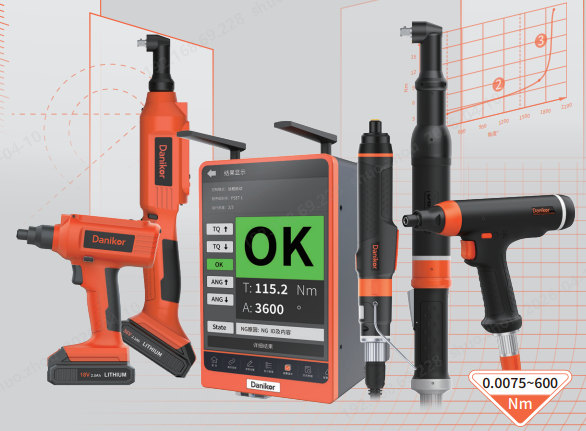
The intelligent electric screwdriver integrates high-precision torque sensors, angle sensors, and an intelligent control system. It overcomes the limitations of traditional electric screwdrivers that rely solely on manual control, achieving precise management of re-tightening error-proofing through digital monitoring and real-time feedback. Its core principle is dual-dimension torque-angle monitoring to accurately identify the tightening state, eliminating the risk of re-tightening at the source.
(I) One-Key Activation of Re-tightening Detection, Simple and Efficient Operation
The re-tightening error-proofing function of the intelligent electric screwdriver is easy to set up, requiring no complex debugging. The operator can activate the repeat tightening detection module with one key. Before use, set the corresponding detection torque threshold and angle window value based on on-site conditions such as screw specifications, workpiece material, and process requirements. During normal tightening, as the screw goes from initial insertion to seating against the workpiece, torque rises smoothly, and the angle increases significantly simultaneously. During repeated tightening, the screw has no space left to rotate; torque rises sharply, but the angle change is minimal. The system compares real-time monitoring data. If it detects an angle that is significantly smaller than expected and falls outside the set window range, it immediately determines re-tightening has occurred, triggers an error signal via audible/visual alarm or on-screen prompt, and forcibly stops the tightening action to prevent damage to the screw and workpiece from excessive force.
(II) Multi-Dimensional Anomaly Detection, Comprehensive Assurance of Tightening Quality
In addition to re-tightening error-proofing, the intelligent electric screwdriver also supports various anomaly detection functions like floating screws (seating issues), cross-threading/slipping, and missed tightening. These can also be activated with one key and set up quickly. Floating screw detection identifies screws that haven't fully seated against the workpiece, preventing loosening due to inadequate tightening. Cross-threading/slipping detection promptly captures thread wear or screw slipping, avoiding ineffective tightening and part damage. These multi-dimensional detection functions work together to form a complete tightening quality error-proofing system, covering risk points throughout the assembly process.
(III) Flexible Parameter Adjustment to Meet Diverse Production Needs
Tightening processes vary significantly across different industries and products. The intelligent electric screwdriver offers powerful parameter customization capabilities. Key parameters like the angle window value and detection torque can be precisely adjusted based on on-site conditions, adapting to various screw specifications (e.g., M0.6 to M10) and workpieces made of diverse materials like metal, plastic, or composites. Additionally, the device supports storing multiple process programs. When switching product models, simply recall the corresponding program without repeated debugging, adapting well to flexible production models involving small batches and many varieties, thus improving line changeover efficiency.
III. Application Value of Intelligent Electric Screwdriver Re-tightening Error-Proofing
The re-tightening error-proofing control of the intelligent electric screwdriver brings multi-dimensional value improvements to manufacturing companies in terms of quality, efficiency, and cost.
On the quality front, it thoroughly solves problems like re-tightening, cross-threading/slipping, and floating screws. The tightening pass rate significantly improves, ensuring product assembly consistency and reliability. Data shows that after applying intelligent screwdrivers, companies see a substantial reduction in assembly defect rates and a significant decrease in after-sales quality issues.
On the efficiency front, real-time anomaly alarms reduce rework and repair steps, prevent defective products from moving to downstream processes, and improve overall line operational efficiency. At the same time, preset parameters and one-key operation lower the skill barrier for operators, reduce training time, and enable new employees to perform standard operations quickly.
On the cost front, it reduces the consumption of screws and workpieces, lowering material costs. It decreases hidden costs like after-sales maintenance and warranty claims. Coupled with data traceability functions, information for each screw tightened (torque, angle, timestamp, operator, etc.) can be recorded and stored, facilitating quality source tracing and process optimization, helping companies achieve production goals of cost reduction and efficiency increase.
In the wave of intelligent manufacturing transformation and upgrading, the refinement and intellectualization of assembly quality control have become an inevitable trend. Centered on re-tightening error-proofing and integrating functions like multi-dimensional detection, parameter adaptability, and data traceability, the intelligent electric screwdriver provides comprehensive, intelligent quality assurance for the screw tightening process. It not only solves the re-tightening challenge of traditional assembly but also drives companies to shift from "manual experience-based control" to "digital intelligent control". It injects strong momentum into the simultaneous enhancement of product quality, production efficiency, and brand competitiveness, becoming an indispensable core piece of equipment in precision manufacturing fields.