Common Tightening Faults: Corresponding Curve Characteristics and Troubleshooting Points
In the actual assembly process, influenced by various factors such as screw quality, operating procedures, equipment parameters, and component status, tightening faults occur frequently. Each type of fault leaves a unique "trace" on the tightening curve. Mastering the characteristics of these curves helps to quickly troubleshoot problems, optimize tightening strategies, and reduce rework rates and component damage.
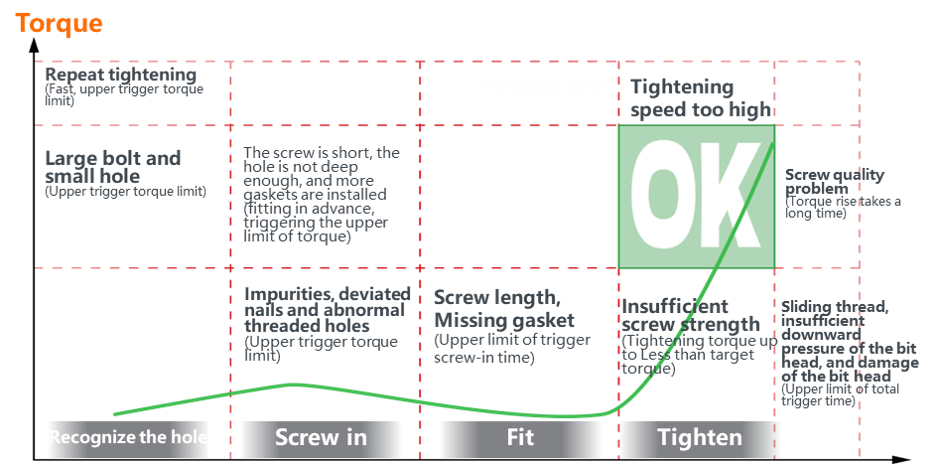
1. Repeated Tightening: The curve rises sharply in a short time, causing torque overshoot.
Repeated tightening is one of the most common faults in practice, mostly caused by operator error or abnormal equipment programs leading to the same screw being tightened twice or more. The core characteristic of the corresponding curve is: within a short period (typically a few seconds), the torque rises sharply, far exceeding the target torque value, creating a "torque overshoot" phenomenon. Normal tightening has a regular, buffered torque rise, but repeated tightening applies torque again on a screw that has already reached the target torque, causing the torque to spike instantly. Measurements from one workstation showed that torque for a repeatedly tightened bolt surged within 3 seconds, whereas the interval for normal tightening needed to be more than 7 seconds. In severe cases, this can lead to bolt fracture. During troubleshooting, focus on checking the equipment's tightening program (whether it has an anti-repeated tightening function) and the operator's adherence to procedures.
2. Floating Screw or Screw Too Short: The curve rises normally, but the tightening angle is too small.
A floating screw (where the screw does not fully seat against the connected part, leaving a gap) or a screw that is too short will cause the tightening process to end prematurely. The characteristic of the corresponding curve is: the torque rise trend is basically the same as a normal curve, with no obvious abnormality, but the tightening angle is much smaller than the standard value. Because the screw does not reach the preset seating depth or has insufficient length, it cannot complete the full elastic deformation phase. Once the torque reaches a certain value, it stops rising, and the angle stops increasing accordingly. This fault leads to insufficient preload, making components prone to loosening. During troubleshooting, check the screw specifications (whether they match the workpiece), whether there is debris on the surface of the connected parts (causing a floating screw), or if the hole depth is insufficient or the hole diameter is too small, preventing normal screw seating.
3. Abnormal Thread/Threaded Hole/Product Surface: Abnormal seating and engagement, curve is irregular.
When the screw threads or threaded holes are damaged, rusted, or blocked by debris, or when the surface of the connected part is uneven or has oil contamination, the screw seating and engagement process becomes abnormal. The corresponding curve lacks a clear phased pattern. Specific manifestations include: torque fluctuating erratically during the thread mating and seating phase instead of increasing smoothly; after entering the seating phase, the torque rise is disordered, possibly showing "sticky" fluctuations (similar to a sawtooth wave), often accompanied by a "creaking" noise during assembly. This occurs because microscopic protrusions on the threads constantly jam and slip, causing abnormal friction fluctuations. Troubleshooting involves cleaning debris from the threads and holes, removing rust, checking threads for scratches or deformation, replacing damaged screws or repairing threaded holes, and applying an appropriate amount of lubricant to reduce friction if necessary.
4. Tightening Speed Too High: Torque overshoot, the curve is steep without buffering.
If the tightening speed is too high, torque is transmitted too quickly. The bolt cannot complete a smooth elastic deformation, leading to torque overshoot. The characteristic of the corresponding curve is: an abnormally steep torque rise without a normal buffering phase, quickly exceeding the target torque value, and the linear relationship between angle and torque is disrupted. High speed prevents the equipment from precisely controlling torque increments, making "overshoot" likely. This not only causes excessive preload but can also lead to bolt deformation or thread stripping. To optimize, adjust the tightening equipment's speed according to the screw specifications and material, which can effectively prevent such issues.
5. Poor Screw Quality or Missing Washer: Under the same torque, the angle is too large.
If a screw has quality defects (e.g., insufficient thread precision, uneven material) or if a washer is omitted during assembly, the resistance during tightening decreases. To achieve the same torque value as in a normal tightening, a larger angle compensation is needed. The characteristic of the corresponding curve is: the torque rises slower, and the angle corresponding to the same torque is much larger than the standard value. For example, when reaching the target torque normally, the angle might be 180°, but with this fault, the angle could reach 250° or more. A missing washer leads to insufficient cushioning of the connected parts, making the screw prone to loosening. Screw quality issues may further lead to subsequent fracture. Troubleshooting involves checking screw quality, verifying the assembly process (confirming whether washers are installed), and reducing the impact of thread errors.
6. Stripped Thread, Bit Slippage, or Damaged Threaded Hole: The angle increases excessively, while the torque shows no significant rise.
Stripped threads (thread wear, loss of engagement), bit slippage (poor fit between the bit and screw head causing slipping), or a damaged threaded hole prevent torque from being effectively transmitted to the bolt. During tightening, the angle continues to increase, but the torque remains at a low level with no significant upward trend. The characteristic of the corresponding curve is: the angle increases significantly, even exceeding the standard value by 2-3 times, but the torque stays low and fails to reach the target value. In some cases, a "sudden force loss" phenomenon may occur, with torque dropping by more than 30%, resembling a roller coaster cresting then suddenly dropping. This happens because the thread teeth have fractured, preventing effective engagement. Troubleshooting involves replacing damaged screws or bits, repairing or re-tapping the threaded hole, increasing the effective thread engagement length, and strengthening the hardness of the thread teeth to prevent this fault from recurring.
Danikor Intelligent Tightening Tools can monitor torque and angle values in real-time throughout the tightening process, automatically generate and store corresponding curves, accurately identify various anomalies such as floating height or thread stripping, and provide real-time feedback on tightening results. This effectively reduces later-stage troubleshooting and rework costs. Additionally, tightening data can be exported and uploaded to MES systems, facilitating subsequent quality traceability and data analysis. Both frontline operators and process optimization engineers should value the analysis and application of tightening curves to further improve tightening accuracy and operational efficiency, providing a reliable guarantee for product quality.