As automotive intelligence enters deeper waters, in-vehicle cameras, serving as the core sensing components of autonomous driving systems, are often called the "eyes" of the car. A single L2+ intelligent vehicle typically carries 8 to 12 cameras. Their assembly quality directly determines the environmental perception accuracy, decision-making reliability, and driving safety of the autonomous driving system. In the assembly process of camera modules, the tightening of micro screws is the most critical and error-prone step. Traditional manual screw tightening can no longer meet the stringent requirements of the automotive industry for precision, consistency, and traceability. The automatic screw fastening machine has become the core equipment to ensure locking quality. This article will deeply analyze how a professional automatic screw fastening system achieves quality control throughout the entire process: from feeding, screw picking, to tightening.
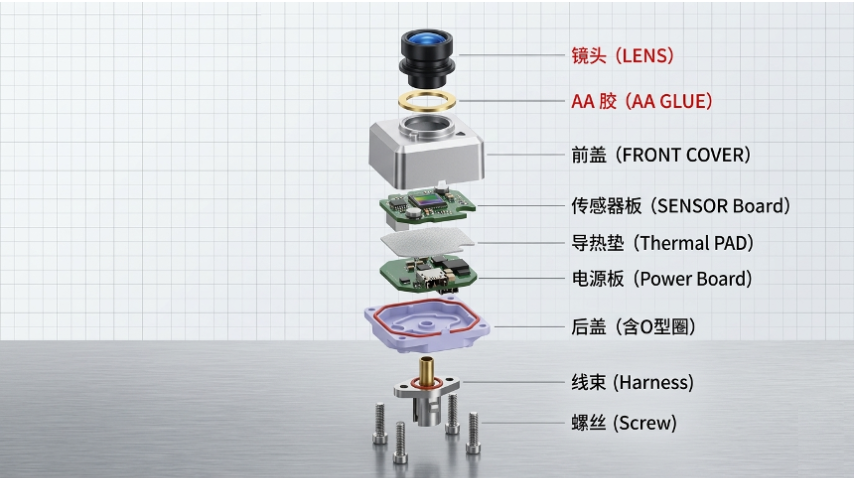
I. Three Core Pain Points in Automotive Camera Screw Locking
Stability Challenge of Micro Screw Feeding: In-vehicle cameras commonly use miniature precision screws of M1.2-M2.0. Some ultra-thin modules even use M0.8 micro screws, with a screw head diameter less than 2mm. Traditional vibratory bowl feeders are prone to jamming, overlapping, or flying screws during high-speed operation. This not only severely impacts production line efficiency, but screw deformation caused by jamming directly leads to poor fastening.
Extreme Requirements for Locking Precision: The coaxiality error between the camera module's lens and sensor must be controlled within 0.02mm. The torque error for screw locking must be less than ±5%. Excessive torque can cause the module housing to crack or the lens to shift. Insufficient torque leads to screw loosening, which under the vehicle's vibrational environment causes camera shake, resulting in blurry images, inaccurate distance measurement, and other critical problems. Manual locking torque errors typically exceed ±15%, and consistency across every screw cannot be guaranteed.
Mandatory Requirements for Full-Process Traceability: The automotive industry implements the IATF 16949 quality management system, which requires that data for all key processes be retained for over 15 years. In case of a quality issue, it must be possible to trace back to the tightening time, torque value, angle value, and operator for each individual screw. Traditional locking methods cannot achieve automatic data acquisition and upload, making it difficult to meet compliance requirements.
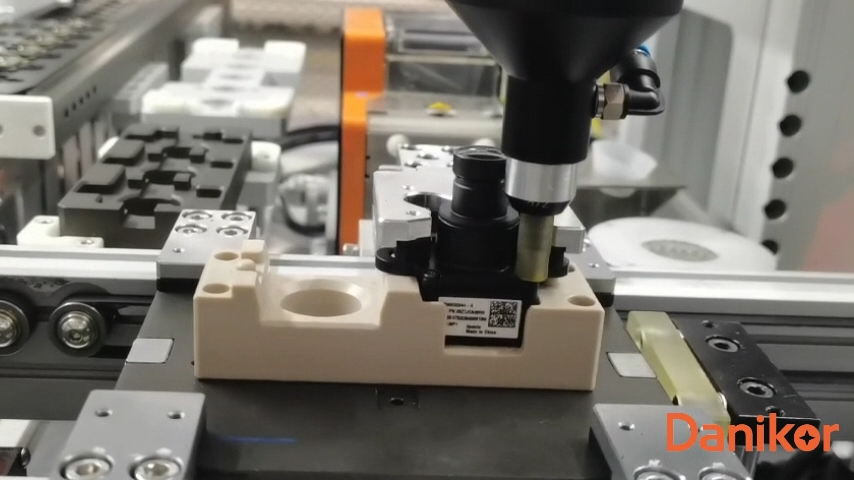
II. Full-Process Quality Control Solution from a Professional Automatic Screw Fastening Machine
A mature automatic screw fastening system for automotive cameras must address three core links: feeding, screw picking, and tightening. Through a combination of hardware innovation and software algorithms, it achieves zero-defect, fully traceable locking results.
(I) Disc Feeder: Foundation for Zero Jamming
The feeding system is a prerequisite for the stable operation of an automatic screw fastening machine. Addressing the characteristics of micro screws (M0.5-M2), Dankor's developed Disc Feeder completely solves the jamming problem common in traditional vibratory bowls. It uses a patented waterwheel-style lifting mechanism that continuously delivers screws to the top of the turntable. Below the turntable, negative pressure generated by a vacuum generator adsorbs screws for feeding. This eliminates the physical possibility of screw jamming, reducing the jamming rate to 0.
(II) Vacuum Pick-up for Screw Extraction: Key to Preventing Tilted or Dropped Screws
The screw pick-up method directly affects locking perpendicularity. For micro screws, even a 1° tilt can cause cross-threading or false seating. The vacuum pick-up method, utilizing the dual structure of "nozzle guidance + negative pressure adsorption", combined with the disc Feeder's repeat positioning accuracy as high as ±0.05mm from Danikor, ensures screw perpendicularity. Additionally, it features a negative pressure monitoring function. If a screw is not successfully picked, picked tilted, or dropped, the system immediately alerts and stops the locking process, preventing defective products from moving to the next process.
(III) Intelligent Electric Screwdriver for Tightening: Achieving Precision Control and Data Traceability
The tightening tool directly determines the quality of locking. Danikor's intelligent electric screwdriver uses dual closed-loop control for torque and angle. Built-in high-precision torque sensors and angle encoders capture torque and angle data in real-time during the tightening process, achieving accuracy up to 6σ ±5%. It can accurately identify various defective tightening conditions:
If torque reaches the set value but the angle does not meet the requirement, it is judged as Cross-threading.
If the angle reaches the set value but torque does not meet the requirement, it is judged as False Seating.
When a defect occurs, the system automatically alerts and marks the defective product, simultaneously uploading data to the MES system. The tightening data for each screw is linked to a unique product serial number, enabling full lifecycle traceability from raw material to the finished vehicle, fully meeting the requirements of IATF 16949.
The locking quality of automotive cameras is directly related to the driving safety of every vehicle owner. A professional automatic screw fastening machine is the core equipment ensuring this locking quality. By adopting the combined solution of a disc Feeder, vacuum screw pick-up, and an intelligent electric screwdriver for tightening, quality control is achieved throughout the entire process of feeding, screw picking, and tightening. This effectively solves the key problems in micro screw fastening, including jamming, tilted screws, insufficient precision, and traceability difficulties.