Application and Fastening Effect Optimization of Torque Screwdrivers in Industrial Assembly
In industrial assembly, equipment assembly, and precision manufacturing scenarios, the reliability of screw connections directly determines the overall product quality. Relying solely on feel or ordinary tools for tightening makes it difficult to achieve stable fastening conditions for every screw. Torque screwdrivers, with their settable and feedback-capable torque output, combined with reasonable speed control, have become common tools for ensuring assembly quality. Correct use of torque screwdrivers can reduce issues such as thread stripping, loosening, and part damage, making connection states more durable.
I. Impact of Speed Selection on Screw Fastening Effects
Many users believe that tightening screws at high speeds can shorten operation time while making connections more secure. However, this is not the case. During the screw insertion process, speed directly changes the friction state and force distribution of the thread pair, thereby affecting the final clamping force.
At low speeds, contact between the screw and workpiece is more stable, the friction state between threads is stable, and force is transmitted evenly, forming a stable axial clamping force. Under these conditions, torque fluctuations are small and overshoot is unlikely to occur, making it suitable for workstations requiring high fastening consistency.
At excessively high speeds, inertial impact occurs between the tool and screw, making overshoot phenomena more likely. Torque fluctuations increase, and the peak clamping force actually decreases. Excessively high speeds may also wear threads, leading to increased subsequent loosening risks—especially in precision parts and soft material assembly where negative effects are more pronounced.
A more reasonable approach in practice is to adopt a high-speed insertion + low-speed fastening combination mode: first use higher speeds to quickly insert the screw into position, then switch to low speed to complete final torque control, balancing process rhythm with fastening quality.
II. How Torque Screwdrivers Stabilize Fastening Output
The core value of torque screwdrivers is transforming vague "tightening" into quantifiable, repeatable operations, avoiding quality fluctuations caused by human force variations.
Torque Presetting and Overload Protection
Torque screwdrivers can preset target torque in advance. When the set value is reached, they trigger feedback through mechanical or electronic means, reminding operators to stop applying force. This prevents over-tightening that damages parts or under-tightening that causes loosening, ensuring every fastening falls within a reasonable range.
Speed and Torque Collaborative Control
Torque screwdrivers support speed adjustment to match requirements of different materials and screw specifications. Hard connections suit steady low speeds, while soft connections can appropriately increase initial speed before finishing at low speed, ensuring stable clamping force.
Data Recording and Process Traceability
Industrial-grade torque screwdrivers can record tightening data for subsequent quality traceability. Through torque curves and tightening result statistics, abnormalities such as floating locks, thread stripping, and missed tightening can be quickly identified, allowing timely optimization of assembly processes.
III. Danikor Torque Screwdrivers Adapt to Multi-Scenario Fastening Requirements
In the industrial tightening field, Danikor torque screwdrivers are designed around actual assembly needs, balancing stability and ease of use, and adapting to scenarios such as automotive components, 3C electronics, and general assembly.
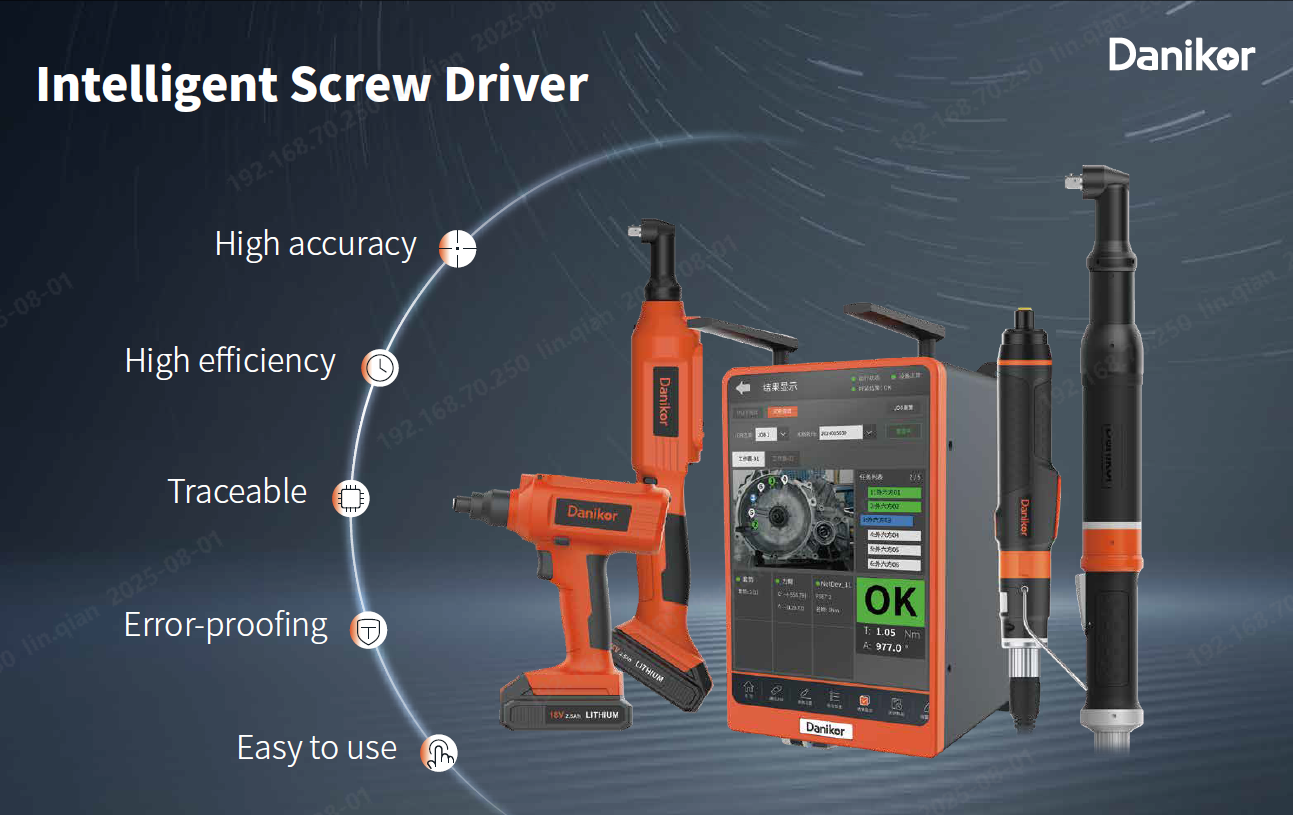
Danikor torque screwdrivers support multi-stage tightening programs, allowing flexible setting of speed and torque parameters, easily achieving the "high-speed insertion + low-speed precision fastening" combination strategy. This reduces inertial overshoot and improves fastening consistency for every screw. The tools feature built-in tightening strategies that can be adjusted according to hard and soft connection characteristics, adapting to different materials and screw specifications.
Meanwhile, the tools possess process monitoring capabilities, capturing parameters such as torque, speed, and angle in real-time, promptly indicating abnormal states and reducing defective products. The body design conforms to handheld operation habits, preventing fatigue during extended operations, making them suitable for continuous assembly workstations.
Screw fastening is not about speed—rather, proper matching of speed and torque is required to achieve stable and reliable connection effects. Torque screwdrivers ensure assembly quality at the tool level through controllable torque output and adjustable speed. Selecting torque screwdrivers adapted to the scenario and following scientific tightening processes not only makes assembly processes smoother but also ensures continuous reliability of product connections, laying a solid foundation for overall quality.