Handheld Electric Screwdriver: Solving the Problems of Missed Screws and Repeated Screwing in Manual Assembly
In manual assembly scenarios, the standardization of screw tightening directly affects the overall product quality. Many workstations rely on human judgment and operation, which can easily lead to issues such as missed screws, repeated screwing, thread stripping (slippage), and floating locks. When combined with an intelligent guidance system, a handheld electric screwdriver can simplify complex processes and make them controllable, improving the tightening status from both the tool and process perspectives, making manual assembly more stable.
I. Why Do Traditional Manual Tightening Processes Often Go Wrong?
Traditional workstations rely heavily on human memory and experience, lacking visual guidance and process control. Common issues focus on three main points:
Missed and Incorrect Screwing: Workpieces often have multiple screw points with complex sequences, making it easy for operators to miss or skip steps.
Repeated Tightening: Without completion markers and status feedback, the same screw may be tightened multiple times, damaging threads and workpieces.
Difficult-to-Control Abnormalities: Thread stripping, floating locks, and torque anomalies are difficult to detect in time, allowing defective products to flow to the next process.
These issues not only affect assembly quality but also increase rework costs. The combination of handheld electric screwdrivers and intelligent systems can reduce such situations from the source.
II. How Does a Handheld Electric Screwdriver with Intelligent Guidance Prevent Missed and Repeated Screwing?
An intelligent graphical guidance system works in coordination with a handheld electric screwdriver, transforming "tightening by experience" into "following steps," with error prevention throughout the entire process.
Visual Navigation, Operation by Diagram
Upload product images in advance and set the tightening sequence. The workstation interface highlights the current point, allowing operators to follow prompts and reducing the memory burden.
Position Verification, Tool Interlocking
The handheld electric screwdriver can only start when aligned with the correct position, preventing incorrect or missed screws at the hardware level and not allowing step-skipping operations.
Real-Time Monitoring, Abnormal Alerts
When floating locks, thread stripping, or torque anomalies occur during tightening, the system immediately alerts the operator. The non-conforming screw must be removed and placed in a scrap bin, and a new screw must be installed and tightened again to ensure compliance of each screw's status.
Task Closure, Preventing Repetition
Once each screw is completed, the system automatically marks its status. The process cannot proceed to the next step until completion, thereby eliminating repeated tightening from the process level.
III. Danikor Handheld Electric Screwdriver: Providing Stable Support for Manual Tightening
Focusing on the pain points of manual workstations, Danikor has launched handheld electric screwdrivers compatible with intelligent guidance systems, balancing ease of use and stability.
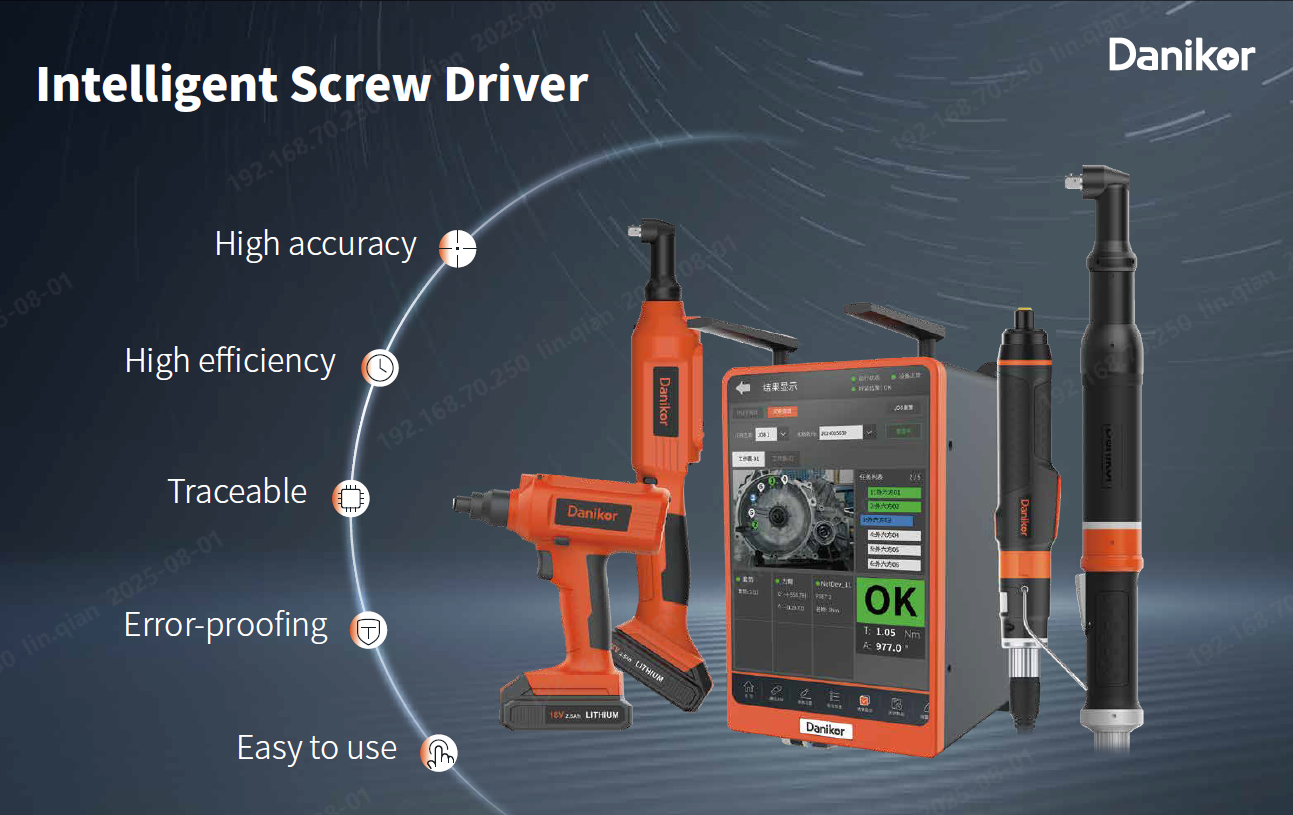
Adjustable Parameters for Multiple Scenarios: Supports multi-stage tightening programs, allowing adjustment of speed and torque according to material and screw specifications, suitable for assembling soft and hard workpieces.
Controllable Process, Traceable Status: Real-time collection of tightening data, cooperating with the system to complete recording and traceability, facilitating quality control.
Error-Proof Design, Reducing Mistakes: Coordinates with positioning torque arms and screw feeders to achieve integrated screw supply, positioning, and tightening, reducing human error.
User-Friendly Operation, Easier for Long-Term Work: The body design fits handheld habits, with auxiliary support structures to relieve operator fatigue, suitable for continuous assembly workstations.
IV. What Are the Key Points for Implementing a Manual Tightening Solution?
Enter product drawings into the system in advance, standardize tightening sequences and parameters, and switch product models with one click.
Scan codes to activate tasks, and the screw feeder automatically supplies materials, reducing the time and errors of manual screw handling.
Strictly follow the highlighted points on the interface, do not force start or skip steps.
Handle abnormalities according to prompts, remove NG screws, replace with new screws, and complete tightening again.
Regularly calibrate handheld electric screwdrivers and systems to maintain stable tool and process conditions.
Manual tightening does not mean rough operation. With handheld electric screwdrivers and intelligent graphical guidance systems, process visualization, error-proof operation, and process traceability can be achieved, effectively solving problems such as missed screws, repeated screwing, and difficult-to-control abnormalities. Danikor handheld electric screwdrivers, with their stable performance and adaptability, have become a common choice for manual assembly workstations, helping enterprises improve assembly quality, reduce defects and rework, and making every tightening more secure.