In many engineering scenarios, we emphasize that bolts must not exceed the yield point, otherwise plastic deformation and irreversible damage will occur, making them unusable for secondary applications. However, in high-reliability scenarios such as automotive engines and critical structural components, there exists a "counter-intuitive" practice—deliberately tightening bolts to the yield point or even slightly beyond the yield zone.
I. What is "Yield Point Tightening"?
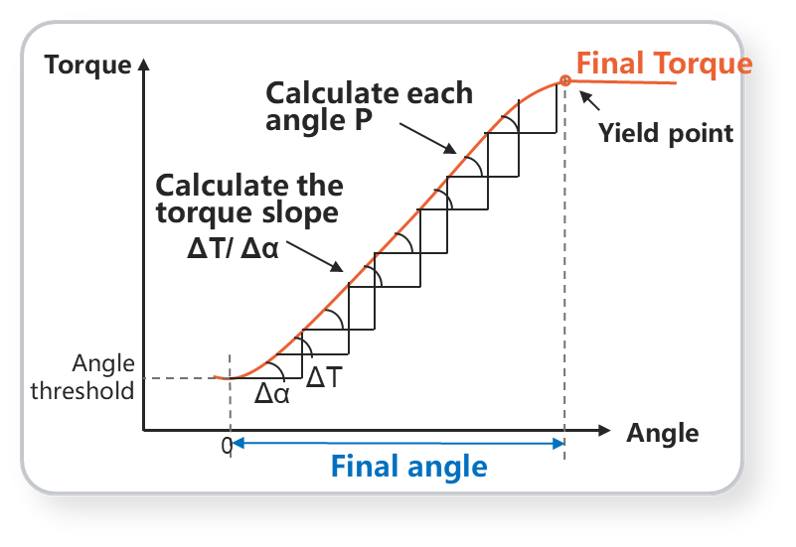
Based on the yield characteristics of bolt materials, during the tightening process, the slope is calculated in real-time—that is, the ratio of torque difference to angle difference—and its changing characteristics are monitored. When entering the plastic deformation zone, the slope begins to decline rapidly. When it drops to 1/3 to 1/2 of the slope in the elastic phase, the yield point is reached.
II. Why Tighten Bolts Beyond the Yield Point?
Safety Factors: The yield point of a bolt is the stress limit at which the material begins to undergo plastic deformation. If the bolt is tightened to or beyond the yield point, it will undergo plastic deformation, thereby absorbing more energy and enhancing the firmness and safety of the connection. In certain critical or high-stress applications, such as aircraft, ships, and nuclear power plants, absolute bolt safety must be ensured, so bolts are deliberately tightened beyond their yield point.
Performance Factors: Tightening bolts beyond their yield point can increase their preload, enabling the bolts to better maintain fastening when subjected to external loads and reducing the likelihood of being pulled out or loosening. Additionally, tightening bolts beyond the yield point can reduce bolt creep and relaxation, maintaining long-term stability and performance of the connection.
It should be noted that tightening bolts beyond the yield point requires careful operation and ensuring that the bolt's ultimate load-bearing capacity is not exceeded, to avoid bolt fracture or excessive plastic deformation leading to performance degradation.
III. Which Industries Use "Beyond-Yield Tightening"?
This process is typically used for high-reliability structural connections, such as: aero-engines, wind power equipment, high-speed train bogies, automotive engines, and new energy batteries. In these scenarios, connection stability is far more important than bolt reusability.
IV. Danikor's Solution
Beyond-yield point tightening generally employs the angle method, achieving the tightening process through a certain starting torque plus angle. Usually, the final tightening point falls after the yield point, but generally the beyond-yield angle is not too large. After all, once tightened beyond yield, the clamping force remains basically unchanged, but the bolt utilization rate has already reached 100%. Danikor's sensor-based intelligent electric screwdriver can monitor torque, angle, and slope changes in real-time, determine whether the yield point has been reached through tightening curve analysis, record the tightening data of each bolt, and achieve full-process tightening quality traceability.